
 eb-stack
Architecture
eb-stack separates package intent, dependency selection, recipe emission,
and empirical build evidence. Every user-facing workflow passes through the
same canonical package model.
Data flow

Command surface
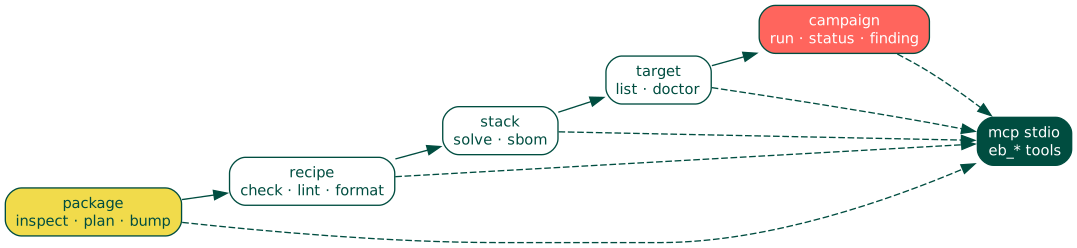
CLI namespaces and matching MCP tools share one workflow graph:
Syntax adapters
The conda adapter expands a restricted template subset, parses classic and v1
recipe shapes, preserves multi-source entries, and represents selectors as
structured conditions. The Spack adapter statically reads package DSL calls;
it does not execute Python. A Python AST evaluator handles literal assignments,
collections, bounded loops, static conditionals, formatting, and nested
with when(...) scopes. It preserves versions, dependencies and roles,
variants, conflicts, requirements, source metadata, and source spans.
A directive enters the canonical model only when its arguments evaluate to static values. Unsupported expressions become source-located residuals instead of partial strings or guessed facts.
Adapters also emit informational notes about successful normalization. Notes never determine whether work remains: only structured residual records cross into the canonical plan and campaign queue. This keeps language used in a diagnostic from changing build behavior.
Adapters do not choose EasyBuild dependency versions or emit placeholder recipes. Their output is package intent plus explicit residuals.
Provider mapping
Layered package policy maps foreign dependency identities to EasyBuild providers after syntax parsing. Direct aliases preserve constraints when the two ecosystems use the same version domain. Component-to-provider aliases can drop a component constraint that has no meaning for the containing provider. The mapping is data, not parser control flow, and dependency provenance keeps the foreign evidence available for review.
Canonical package model
PackagePlan is schema-versioned and shared by foreign imports and bumps. It
contains package metadata, provenance-bearing sources and dependencies,
structured conditions/rules, EasyBuild build intent, product profiles, output
requests, and residuals.
The planned SBOM is derived from this model. It is marked pre-build and remains separate from installed/binary evidence.
Product profiles
Profiles represent independently installable products. Materialization applies feature flags, dependency-feature values, compiler/toolchain/platform context, variables, versionsuffix components, toolchain options, configuration options, and verification commands.
The emission invariant is one profile lock and one conventional .eb file per
requested profile. The default CPU/MPI/OpenMP product is unsuffixed unless the
site explicitly defines a distinct loadable variant.
Resolvo boundary
The solver receives:
the materialized direct dependency requirements;
candidates filtered through the EasyBuild toolchain hierarchy;
preferred or locked stack pins;
candidate exclusions backed by target/build evidence.
Preferred pins use Resolvo’s favored candidate and retain an in-solver fallback. Locked pins constrain selection to one candidate. Pin outcomes and exclusions are serialized in the profile lock.
Existing robot recipes are already-built artifacts. Their build-only tools have independent build contexts and are not forced into the generated package’s co-loaded runtime closure. Direct build requirements of the generated profile remain solver requirements and are emitted as build dependencies.
exts_list entries become virtual candidates (easyconfig_path contains
#ext:) that depend on the parent bundle. A requirement for numpy is
therefore satisfied by selecting SciPy-bundle. Profile locks collapse the
provide to the parent so emission never writes a standalone numpy
dependency tuple. The expansion is idempotent and runs inside Resolvo
admission, so unsatisfied_direct_dependencies sees the same universe.
Deterministic EasyBuild emission
New-package emission renders package metadata, all sources and checksums, EasyBuild build settings, locked dependency tuples, profile toolchain options, configuration, sanity paths, and module class. Bumps preserve the source recipe’s syntax and unrelated bytes while applying the canonical lock to the toolchain, package version, dependency versions, and source checksum entry.
Layered targets
A target is four orthogonal layers:
transport: local or SSH;
executor: direct or Slurm;
runtime: host, Podman, or Docker;
EasyBuild workload: command, robot paths, durable roots, and environment.
TOML layers merge by target name in argument order. This keeps the public repository and skills portable while a private site layer supplies hostnames, paths, modules, scheduler sizing, and container images.
Compiled EasyBuild modules, work trees, and temporary roots belong to one
runtime ABI. A container target therefore uses its own EASYBUILD_INSTALLPATH,
work_root, and tmp_root. Source archives may use a shared cache because they
do not contain host-linked executables.
Persisted campaigns
A campaign stages one bundle, builds every emitted recipe, and runs profile verification commands. Its state stores attempts, exact routed commands, compact evidence, typed findings, ownership, resolutions, and the three claims.
Spawn, controller interruption, and exit failures are data, not lost control flow. They are classified as transport, executor, runtime, interrupted, checksum, patch, dependency, configure, compile, link, test, install, sanity, resource, timeout, or unknown findings. Hermes drives retries; OMP workers coordinate through claim/resolve operations.
API surface
The CLI and MCP server expose the same version-one workflows. Internal parser and syntax-preserving emit modules are not compatibility APIs. There is one canonical route for new packages and one for bumps, both ending in the same bundle and campaign model.