
 eb-stack
The optimization model
eb-stack uses resolvo, a CDCL SAT
solver, as its feasibility core. CDCL SAT answers one question well: does a consistent assignment exist under the requirements given. It does not, by
itself, answer which consistent assignment is best when more than one
exists and a policy has more than one root. eb-stack adds a small
optimization layer on top of feasibility to answer that second question
deterministically.
Why feasibility alone is not enough
resolvo’s own candidate ordering
(resolvo_provider::EbProvider::sort_candidates) sorts each individual
package’s candidates newest-first, so the solver’s internal search leans
toward newer versions. That is a per-package heuristic for the SAT search,
not a joint, policy-aware optimum across every root. With a single root, the
newest jointly-feasible version and the heuristic’s pick coincide, because
there is only one root to satisfy. With two or more roots that share a
dependency and disagree about its version, “which root’s newest version
wins” is not determined by that heuristic: it can depend on incidental input
order rather than anything a policy author declared.
A conflict between two roots
# GROMACS's newest easyconfig
dependencies = [('OpenMPI', '==4.1.6')]

# LAMMPS's newest easyconfig
dependencies = [('OpenMPI', '>=5.0.3')]
Only one OpenMPI version is co-selected per lock, so GROMACS’s newest
and LAMMPS’s newest cannot both be selected: whichever root keeps its
newest version forces the other one down to whatever version of it is
compatible with the winning OpenMPI. Plain feasibility says “a solution
exists”; it does not say which root’s newest version that solution should
favor. See the how-to for this exact
fixture solved both ways.
The priority-lexicographic layer
solve_with_resolvo (in resolvo_provider.rs) resolves the ambiguity with
sequential lexicographic maximization over
Policy::effective_root_priority: fix the highest-priority root’s version
first, keep it fixed, move to the next root, and so on.
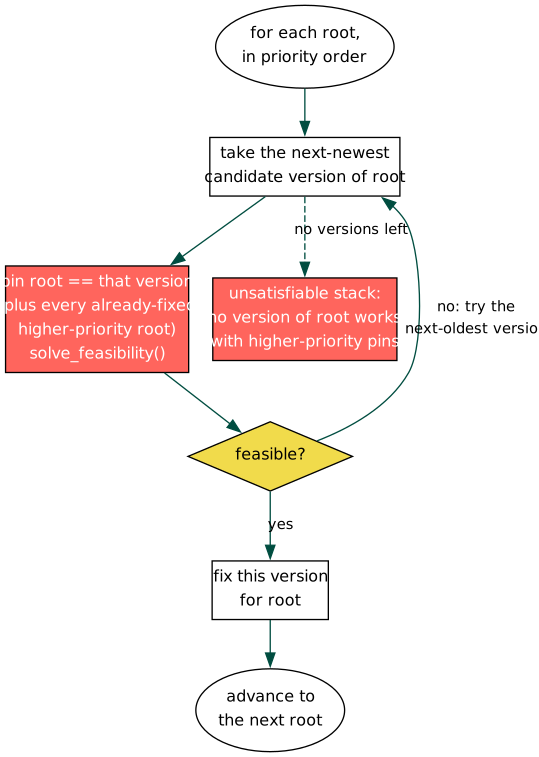
Each trial re-solves feasibility (a fresh resolvo SAT call) with the
candidate version pinned as an exact requirement alongside every
higher-priority root’s already-fixed version. The first version that keeps
the whole trial feasible is kept; the loop never backtracks past a
higher-priority root once fixed. After every root has a fixed version, one
final solve with all root pins in place produces the lock – non-root,
non-priority packages still prefer newer via resolvo’s own
sort_candidates heuristic, since nothing forces them to a specific
version.
This priority layer is deliberately not a joint, whole-stack optimum: it is a
lexicographic optimum over the declared priority order. That is a stronger
guarantee than plain SAT feasibility, and it is enough to make multi-root
outcomes depend only on the policy (including root_priority) and the
candidate set – never on incidental candidate list order or map iteration
order. It is not a claim that the result maximizes some single scalar
objective across every co-selected package simultaneously; a true
multi-objective optimum would need a different (and considerably more
expensive) formulation on top of the same SAT core.
What this guarantees in practice
Single-root policies: priority reduces to one root, so this is “newest feasible version of the root plus newest feasible everything else” – the common case, and the fast path.
Multi-root policies with no shared-dependency conflict: every root gets its newest version; the priority order never has to break a tie.
Multi-root policies with a conflict: the declared
root_prioritydecides, not candidate list order, notHashMapiteration, not which root happened to be listed first inroots.